Why Small Workplace Interruptions Cost More Than Most Businesses Realize
Short breaks, coffee trips, and small disruptions add up to measurable productivity loss across organizations.

Productivity Loss Rarely Comes From Big Problems
When businesses evaluate productivity, they often focus on major disruptions, outages, staffing shortages, or missed deadlines.
In reality, many operational losses come from small repeated interruptions that seem insignificant individually but compound over time.
These moments occur daily and are often accepted as normal workplace behavior.
The Accumulation Effect
A single interruption may last only a few minutes:
- leaving the building briefly
- searching for refreshments
- waiting for shared resources
- restarting tasks after breaks
Individually they appear harmless. Across a team, they become measurable workflow gaps.
Because they are distributed throughout the day, they rarely appear in reporting yet consistently impact output.
Why Re-Focusing Takes Longer Than the Break
After switching tasks, the brain requires time to restore concentration.
This means a 10-minute interruption often affects 15–20 minutes of productivity due to transition time.
The loss is not only the absence, it is the recovery.
Operational Impact on Teams
Repeated workflow interruptions affect:
- meeting timing
- collaboration pacing
- response speed
- task completion consistency
Organizations experience the effects as slower operations rather than identifiable downtime.
Convenience and Workflow Efficiency
Employees naturally seek efficiency in their environment.
When routine needs require leaving the workflow, habits form that extend the interruption beyond its original purpose.
Providing accessible resources reduces friction and helps maintain task continuity.
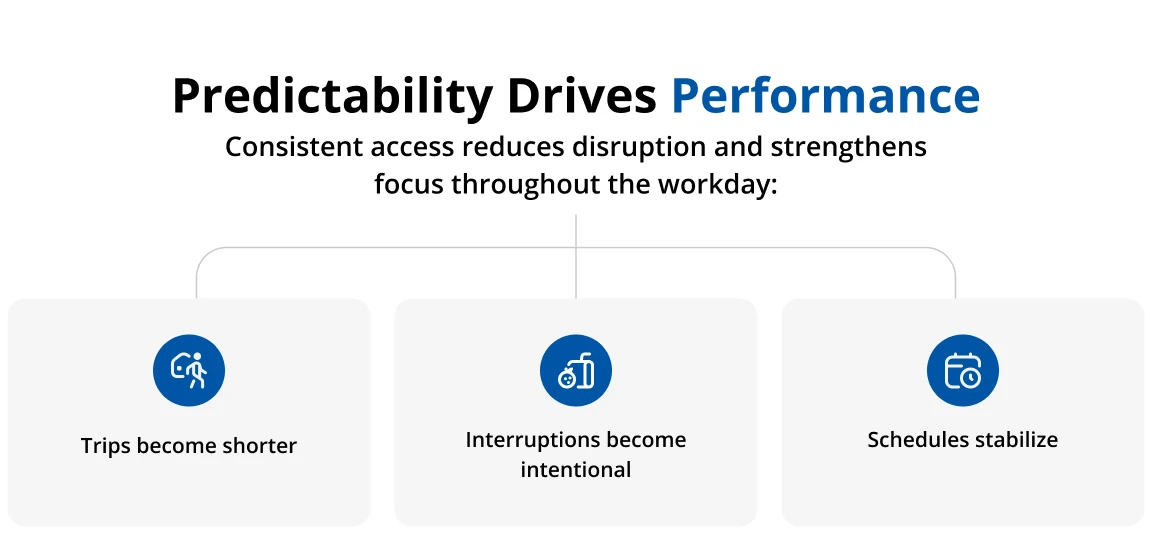
Predictability Improves Performance
Consistent availability allows employees to plan short breaks without uncertainty.
When access is predictable:
- trips become shorter
- interruptions become intentional
- schedules stabilize
Reliability reduces cumulative disruption.
Why Businesses Often Miss the Pattern
Because interruptions are spread across individuals and departments, the impact appears as general inefficiency rather than a specific problem.
It is easier to see large operational failures than gradual time fragmentation.
Small interruptions rarely appear important, yet repeated daily across teams they become a measurable operational cost. Organizations improve efficiency not only by working faster, but by reducing the number of times workflow must restart.
Understanding this pattern helps businesses evaluate convenience as part of productivity strategy rather than just an amenity.

Have a topic you’d like us to cover?
Contact us and let us know how we can help!
You Might Also Like:
Explore our latest and most popular posts, updated regularly to keep you in the know.