Why Are Employees Drinking Specialty Coffee at Home but Settling for Basic Coffee at Work?
Specialty coffee is now part of everyday life. Here's why workplace coffee programs should keep pace with what employees enjoy outside the office.
Think about how much coffee has changed over the past decade.
People have espresso machines in their kitchens. They're experimenting with different roasts.
They're buying freshly roasted beans. They're drinking cold brew in December.
And they know exactly what they like. Then they walk into the office.
And there's a pot of coffee that's been sitting on a warmer since 8:15 a.m.
Something isn't adding up.
Specialty coffee has become part of everyday life, but many workplaces still approach coffee as a basic amenity rather than an experience worth improving.
At Capitol Coffee, we believe that deserves another look.
Because today's employees aren't necessarily asking for luxury.
They're asking for the same quality, choice and convenience they've come to expect everywhere else.
And the businesses that recognize that shift have an opportunity to create a workplace people genuinely enjoy spending time in.
Specialty Coffee Isn't Just for Coffee Shops Anymore
Let's start with the numbers.
According to the National Coffee Association (NCA), specialty coffee consumption reached a new record in 2026.
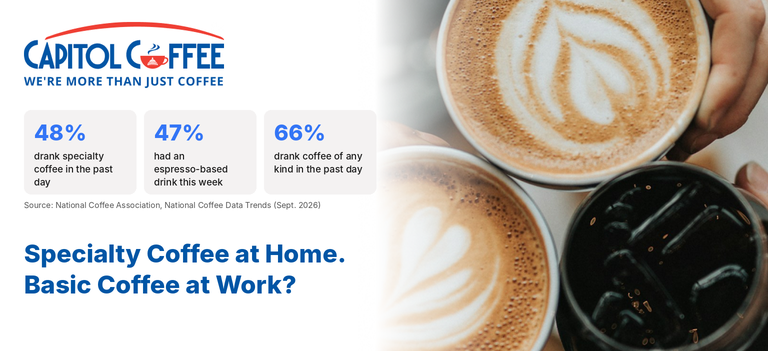
Its September National Coffee Data Trends report found that 48% of American adults consumed specialty coffee in the previous day.
That's a significant development.
Specialty coffee, once associated primarily with independent cafés and coffee enthusiasts, has become an increasingly familiar part of everyday consumer behavior.
The same report found that 47% of American adults had an espresso-based beverage within the previous week.
And overall, 66% had consumed coffee in the past day. Consumers have become accustomed to having options. They know the difference between coffee they enjoy and coffee they're simply willing to drink.
And while preferences vary, one thing is clear:
The definition of a good coffee experience is evolving.
The question for employers is whether their workplace amenities are evolving alongside it.
The Coffee Experience Doesn't Reset When Employees Clock In
Consider a typical morning.
An employee wakes up and makes a cup of freshly ground coffee at home.
Maybe they have a favorite local roaster.
Maybe they use a bean-to-cup machine.
Maybe they prefer a latte.
Maybe they grab cold brew from their neighborhood café on the way to work.
Whatever their routine, they've developed expectations around taste, freshness and convenience.
Then they arrive at the office.
What happens next?
Are they greeted by a coffee experience that reflects those preferences?
Or does the workplace offer one option, regardless of what employees actually enjoy?
This isn't about expecting every office to become a coffee shop.
It's about recognizing that employees don't stop being consumers when they enter the workplace.
The preferences they develop outside the office influence how they experience the amenities inside it.
That creates an important opportunity for workplace leaders.
Instead of asking whether the office provides coffee, perhaps the better question is:
Does the coffee we're providing reflect what our employees actually want?
Providing Coffee and Providing Good Coffee Are Two Different Things
For years, workplace coffee programs were often evaluated through a relatively simple lens.
Is coffee available?
Is it affordable?
Is the equipment working?
Can employees get a cup when they need one?
Those questions still matter.
But they're only part of the equation.
Today, workplace coffee should also be evaluated through the experience it creates.
Quality: Does the coffee taste good consistently?
Variety: Are there options for different preferences?
Convenience: Can employees get what they want without unnecessary effort?
Reliability: Is the equipment maintained and ready throughout the workday?
Service: When something goes wrong, is there a partner who can resolve it?
A workplace might technically provide coffee while falling short on several of these dimensions.
And that gap matters.
Because employees don't experience amenities as a checklist.
They experience them through everyday moments.
The first cup of the morning.
The coffee they grab between meetings.
The drink they offer a visiting client.
The break they share with a colleague.
The quality of those small experiences contributes to how a workplace feels.
Not every moment needs to be extraordinary.
But it should be thoughtfully considered.
Why Workplace Coffee Quality Matters More Than You Might Think
Coffee is one of the most frequently used shared amenities in many workplaces.
Unlike an occasional company event or annual employee gift, coffee can be part of someone's routine every working day.
That makes it an interesting opportunity.
A relatively small experience, repeated consistently, can become part of how people perceive their workplace.
Think about the difference between two offices.
In the first, employees grab whatever coffee is available.
They might drink it.
They might not.
Some leave the building to get something they prefer.
Others bring coffee from home.
In the second, employees have access to fresh coffee, several beverage choices and equipment that works reliably.
The experience feels intentional.
Neither workplace is defined entirely by its coffee program.
But one has clearly put more thought into an everyday employee need.
That's the opportunity.
A better coffee program won't solve every workplace challenge.
It won't automatically improve retention.
And it certainly won't replace strong leadership, fair compensation or a healthy company culture.
But it can make one part of the employee experience noticeably better.
Sometimes, that's exactly where meaningful improvements begin.
Today's Employees Want Choice, Not Just More Coffee
One of the most important changes in coffee culture is the growing diversity of preferences.
Some people love traditional drip coffee.
Others prefer espresso.
Some want cold brew.
Some enjoy lighter roasts.
Others want something bold and familiar.
And some would rather have tea or another beverage entirely.
A modern workplace coffee program should recognize that there isn't one perfect drink for everyone.
That doesn't mean every business needs every possible beverage option.
It means the program should be designed around the people using it.
For a smaller office, that might mean upgrading the quality of its everyday coffee.
For a larger workplace, it might mean offering multiple brewing methods.
For an office with strong demand for espresso drinks, a bean-to-cup system could be worth exploring.
For a workplace where cold beverages are popular, cold brew may be a useful addition.
The right solution depends on the environment.
A good workplace coffee program isn't necessarily the most elaborate one.
It's the one that fits.
What About Employees Who Don't Drink Coffee?
They're part of the equation, too.
Workplace refreshment programs shouldn't be built around a single beverage category.
Tea, hydration, sparkling water and other refreshments can help accommodate different preferences.
At Capitol Coffee, we believe the broader breakroom experience should reflect the diversity of the people using it.
Because a thoughtful workplace doesn't assume everyone wants the same thing.
Better Coffee Starts With Better Questions
Before upgrading equipment or adding new beverages, employers should understand what their employees actually want.
That begins with asking.
Not guessing.
A short employee survey can reveal useful information about daily coffee habits and workplace preferences.
Consider questions such as:
What coffee or beverages do you typically drink during the workday?
Do you usually bring coffee from home, make it at work or purchase it elsewhere?
What would make the workplace coffee experience better?
Which matters most: quality, variety, convenience or speed?
Are there beverages you'd like available that aren't currently offered?
These questions help workplace leaders move beyond assumptions.
For example, a business might believe employees want more flavor options when the real issue is inconsistent brewing quality.
Another might invest in premium equipment when employees would be happier with fresher coffee and more reliable service.
The objective isn't to make the program more complicated.
It's to make it more relevant.
And that's where an experienced workplace coffee partner can help.
Equipment Matters. But It Isn't the Whole Experience.
It's tempting to think a better coffee program begins and ends with buying a new machine.
Sometimes equipment is part of the solution.
But equipment alone doesn't guarantee a great experience.
Coffee quality depends on several connected factors.
The beans.
The brewing method.
Water quality.
Equipment calibration.
Cleaning.
Maintenance.
Replenishment.
And the service supporting the program.
A premium machine using coffee employees don't enjoy won't necessarily solve the problem.
Neither will excellent coffee brewed through poorly maintained equipment.
A successful workplace coffee program brings the entire experience together.
That's an important distinction for businesses evaluating their options.
The goal shouldn't simply be to install something impressive.
The goal should be to create a reliable experience employees appreciate.
Why Consistency Matters
Think about your favorite coffee shop.
Part of the reason you return is that you know what to expect.
The coffee you enjoyed last Tuesday should taste just as good this Tuesday.
That consistency builds confidence.
Workplace coffee should aim for the same principle.
Employees shouldn't have to wonder whether the machine will be working or whether the coffee will taste right.
When the experience is dependable, it becomes an easy part of the day.
And when it isn't?
People notice.
Local Coffee Can Make the Workplace Experience More Meaningful
There's another dimension to workplace coffee that often gets overlooked.
Where the coffee comes from.
Businesses increasingly have opportunities to create workplace experiences that reflect their region and community.
Coffee is one way to do that.
Capitol Coffee's relationship with Lil' Red Roaster, rooted in Wake Forest, North Carolina, brings local roasting expertise into the workplace coffee conversation.
It's an opportunity to connect quality coffee with a recognizable regional story.
Instead of offering an anonymous cup of coffee, businesses can offer something with a sense of place.
A roaster.
A community.
A commitment to craft.
And a product employees can feel good about sharing with colleagues or visitors.
Of course, local sourcing alone doesn't guarantee better coffee.
Quality, consistency and service still have to deliver.
But when those elements come together, the experience becomes more distinctive.
For businesses across the Carolinas and surrounding markets, that's worth considering.
Good workplace coffee can do more than fill a cup.
It can help express what a business values.
Is Your Workplace Coffee Program Keeping Up?
Here's a simple exercise.
Think about the coffee your employees drink when they're not at work.
Now think about what you're offering them in the breakroom.
How different are those experiences?
The answer doesn't automatically mean your program needs replacing.
But it may reveal an opportunity.
A good place to start is with five questions:
1. Do employees actually enjoy the coffee?
Availability doesn't equal satisfaction.
2. Are there options for different preferences?
A single brewing method may not reflect the needs of every workplace.
3. Is the experience convenient?
Employees should be able to get a good cup without unnecessary delays or frustration.
4. Is the program reliable?
Equipment performance, replenishment and responsive service matter.
5. Does the program reflect the workplace you're trying to create?
A thoughtful coffee experience should complement the culture and expectations of the people using it.
If you're unsure about several of these answers, that's a useful starting point for a conversation.
Not necessarily about spending more.
But about making the program work better.
The Future of Workplace Coffee Is About Meeting People Where They Are
Specialty coffee isn't going away.
Neither are evolving consumer expectations.
People are discovering new beverages, developing stronger preferences and paying more attention to the quality of what they drink.
Those habits naturally create new questions for workplace leaders.
Should we offer more variety?
Would employees appreciate better coffee?
Is our equipment still the right fit?
Are we providing a convenient experience?
Could our breakroom feel more welcoming?
These are practical questions.
And they deserve practical answers.
At Capitol Coffee, we believe workplace coffee should be designed around the people who drink it and the businesses that depend on it.
That means balancing quality with convenience.
Choice with simplicity.
And a great cup of coffee with the reliable service required to deliver it.
Because employees shouldn't have to lower their coffee expectations when they arrive at work.
The workplace should be ready to meet them.
Frequently Asked Questions
What is specialty coffee?
Specialty coffee generally refers to coffee associated with higher quality standards, distinctive flavor characteristics and greater attention to sourcing and preparation. In consumer research, the National Coffee Association uses a broader definition that includes premium brewed coffee and specialty beverages such as espresso drinks and cold brew.
Why should businesses offer specialty coffee at work?
Specialty coffee can provide employees with greater beverage choice and a higher-quality experience. The value depends on employee preferences, the workplace environment and the reliability of the program.
What is the best coffee system for an office?
There isn't one system that's best for every workplace. The right choice depends on employee count, beverage preferences, daily consumption, available space, budget and service requirements.
Can better office coffee improve employee satisfaction?
A better coffee experience may improve satisfaction with workplace amenities, particularly when employees value quality, convenience and variety. However, coffee alone should not be treated as a proven driver of overall employee satisfaction or retention.
What should companies look for in an office coffee service provider?
Businesses should evaluate coffee quality, equipment options, beverage variety, maintenance, replenishment, responsiveness and the provider's ability to adapt as workplace needs change.
Sources & Further Reading
- National Coffee Association (September 15, 2026) - Coffee Tops Beverage Charts Again, Specialty Coffee Hits New High
- National Coffee Association (June 2, 2026) - Specialty Coffee Consumption Remains at Record High
Ready to Rethink Your Workplace Coffee Experience?
Whether you're evaluating an existing coffee program or exploring new options, Capitol Coffee can help you consider the right combination of coffee, equipment, beverages and service for your workplace. Explore Capitol Coffee's Workplace Coffee Solutions.
Better coffee. Better experiences. Built around your workplace.

Have a topic you’d like us to cover?
Contact us and let us know how we can help!
You Might Also Like:
Explore our latest and most popular posts, updated regularly to keep you in the know.