The 2027 Workplace Won't Be About Getting People Back to the Office. It'll Be About Making the Office Worth Coming Back To.
Office attendance expectations are rising. In 2027, the bigger question is whether the workplace gives people a reason to come back.
For several years, one question dominated conversations about the workplace:
How do we get people back to the office?
Companies debated mandates.
Employees debated flexibility.
Leaders debated how many days people needed to be together.
But as businesses begin planning for 2027, there's another question worth asking:
What happens once people actually get there?
The next evolution of the workplace may be less about attendance and more about experience.
Because requiring someone to come into an office and creating a workplace they genuinely value are two very different things.
The Return-to-Office Conversation Is Changing
Office attendance expectations are increasing.
CBRE's 2026 Americas Office Occupier Sentiment Survey found that 89% of surveyed companies now require employees to work from the office at least three days per week, up from 78% the previous year.
But there's an interesting disconnect.
Only 14% of surveyed companies are making major workplace improvements, even though 62% identify enhancing employee experience as a priority.
That creates what we believe will become an increasingly important workplace question in 2027:
If you're asking people to spend more time somewhere, are you also making that place better?
Not more extravagant.
Better.
More useful.
More welcoming.
More convenient.
More connected.
In 2027, the Office Needs a Reason
For many employees, home has become an incredibly efficient place to work.
There's no commute.
The coffee is exactly how they like it.
The kitchen is ten steps away.
The temperature is under their control.
And nobody booked the conference room they wanted.
The office can't compete with home simply by being an office.
But it can offer something home can't.
People.
Hilton's 2026 workplace research found that 94% of workers surveyed believe returning to the office serves a purpose, with the workplace increasingly functioning as a hub for relationships and connection.
That's an important distinction.
The office of 2027 doesn't necessarily need to beat the home office at individual work.
It needs to become better at the things people come together to do.
Connect.
Collaborate.
Learn.
Build relationships.
Share ideas.
And occasionally talk about something other than work while waiting for the coffee machine.
Small Experiences Are Becoming More Important
When businesses think about workplace experience, it's easy to immediately think about major renovations.
New furniture.
Collaboration spaces.
Technology.
Office design.
Those things matter.
But workplace experience is also built through much smaller moments.
What happens when someone arrives in the morning?
Where do coworkers naturally encounter one another?
Can someone grab something to eat without leaving the building?
Is water readily available?
Is there somewhere comfortable to take a break?
Is the coffee actually good?
These aren't headline-grabbing workplace investments.
They're everyday ones.
And because they're experienced repeatedly, they can have an outsized influence on how a workplace feels.
The Breakroom Has a Bigger Job Now
For decades, the breakroom had a fairly straightforward purpose.
Coffee machine.
Refrigerator.
Microwave.
Maybe a vending machine.
Done.
But if the office increasingly exists to create connection, shared spaces take on a different role.
The breakroom can become one of the few places where people from different departments naturally cross paths.
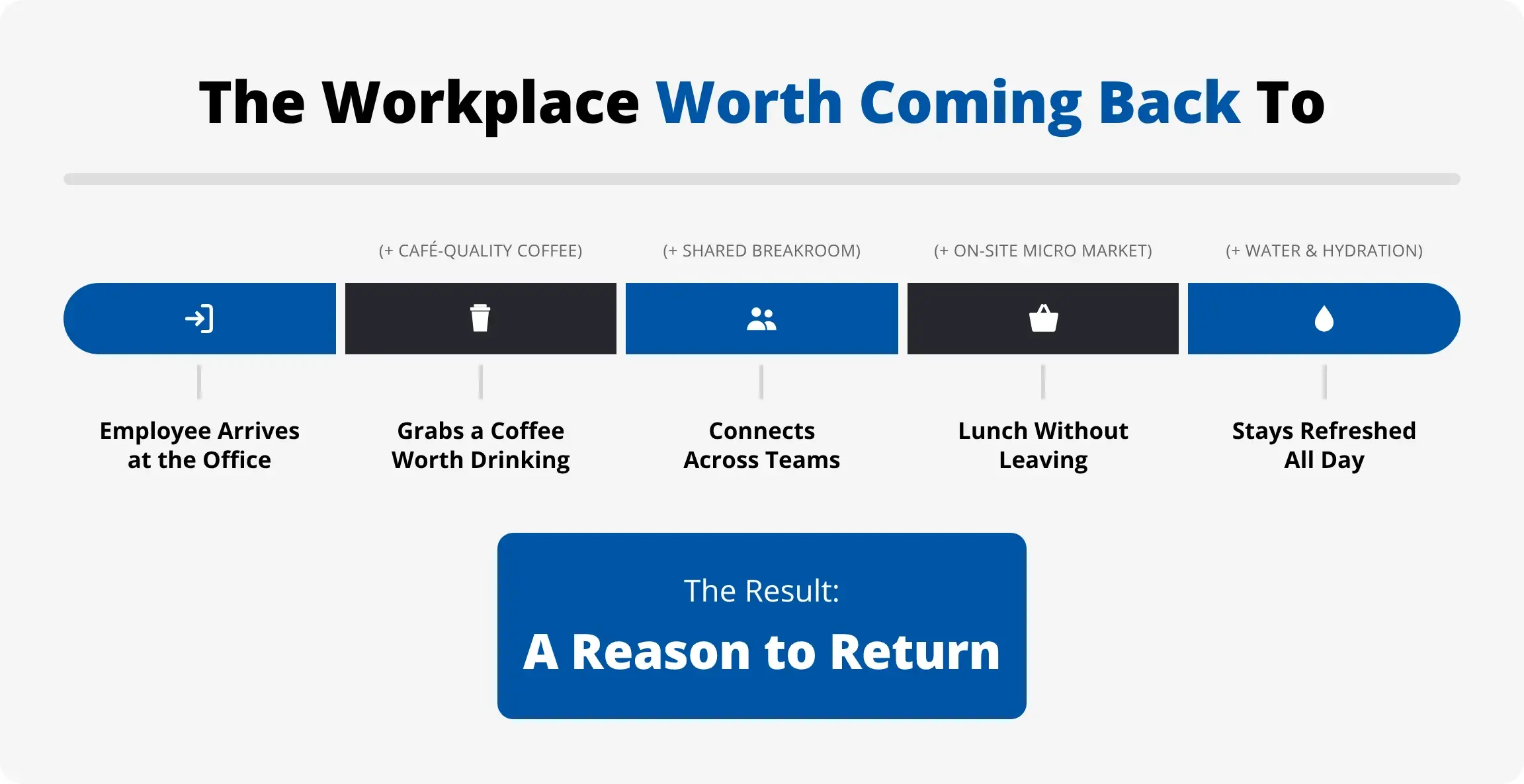
Coffee becomes an excuse to step away from a screen.
A micro-market gives employees somewhere to grab lunch without immediately leaving the workplace.
A better beverage program creates something employees can enjoy together.
None of these amenities creates company culture by itself.
That's an important distinction.
But they can create conditions where interaction happens more naturally.
That's a much more useful way to think about workplace amenities.
Not as perks.
As infrastructure for a better day.
Coffee Is a Small Example of a Much Bigger Shift
We spend a lot of time thinking about workplace coffee at Capitol Coffee.
But coffee illustrates something much larger about where workplace expectations are going.
Employees increasingly have better coffee at home.
They know what they like.
They may drink espresso, cold brew or specialty coffee rather than whatever happens to be in the pot.
When they arrive at work, those expectations don't disappear.
The same applies to food.
Hydration.
Convenience.
Technology.
Comfort.
People compare their workplace experience to the rest of their lives, not just to other offices.
That's why the 2027 workplace conversation shouldn't simply be:
What amenities do we provide?
It should be:
Are these amenities actually designed around the people using them?
Hospitality Might Be the Better Model for 2027
There's another idea gaining momentum in workplace strategy that we think is particularly interesting.
Hospitality.
Hilton's recent workplace research describes a shift toward a "hospitality mindset," where the workplace becomes less transactional and more intentionally designed around how people feel when they're there.
That doesn't mean every office needs to become a hotel.
It means businesses can borrow a fundamental hospitality principle:
Think about the experience from the guest's perspective.
For employers, substitute "employee."
What happens when they arrive?
What do they need throughout the day?
Where does friction exist?
Where can you make something easier?
Where can people connect?
Where can you make someone feel considered?
Those questions can lead to surprisingly practical improvements.
Before You Plan for 2027, Ask Better Questions
Instead of asking only how many days employees should be in the office, workplace leaders might ask:
Why should employees want to be here?
What experiences are genuinely better together?
Where do people naturally connect?
What causes unnecessary friction during the day?
Do our amenities reflect how people actually work now?
Are we investing in attendance, or are we investing in experience?
The answers will look different for every workplace.
That's the point.
There isn't one office model for 2027.
There are workplaces intentionally designed around the people using them.
Make the Office Worth the Trip
Getting people through the door is one challenge.
What happens after they walk through it is another.
As businesses look toward 2027, the opportunity isn't necessarily to build a more elaborate office.
It's to create a more thoughtful one.
A place where people can work well.
Connect naturally.
Find what they need.
Feel considered.
And yes, get a genuinely good cup of coffee without leaving the building.
Because the future of the workplace isn't simply about bringing people back.
It's about giving them something worth coming back to.
Frequently Asked Questions
What workplace trends will shape 2027?
Current workplace research points toward increased office attendance expectations alongside greater emphasis on employee experience, connection, hospitality and spaces designed for collaboration.
Are companies increasing return-to-office requirements?
Yes. CBRE's 2026 survey found 89% of surveyed companies required at least three in-office days per week, compared with 78% the previous year.
Why are workplace amenities important?
Well-designed amenities can make everyday workplace experiences more convenient and create shared spaces where employees naturally interact. They should support workplace culture rather than be treated as substitutes for it.
What is workplace hospitality?
Workplace hospitality applies hospitality principles such as welcoming people, reducing friction and anticipating needs to the employee experience.
Sources & Further Reading
- CBRE - 2026 Americas Office Occupier Sentiment Survey
- Hilton - 2026 Workplace Culture Trends Report: The Hospitality Mindset
Rethink Your Workplace Experience
Coffee, food, hydration and shared spaces all shape whether the office feels worth the trip. Capitol Coffee can help you plan amenities around the people using them. Rethink Your Workplace Experience With Capitol Coffee.

Have a topic you’d like us to cover?
Contact us and let us know how we can help!
You Might Also Like:
Explore our latest and most popular posts, updated regularly to keep you in the know.