Office Coffee vs Coffee Shop Costs
Employees leaving for coffee costs more than you think. Learn the real financial impact and how businesses reduce lost productivity.

Coffee Breaks Aren’t Just About Coffee
Most workplaces accept coffee runs as part of the day. Employees step out, grab a drink, and return to work.
But when this happens repeatedly across a team, the impact goes beyond beverage preference, it becomes an operational cost.
Businesses rarely calculate the time and workflow disruption caused by off-site refreshment trips, yet it affects productivity every day.
The Time Cost of Leaving the Workplace
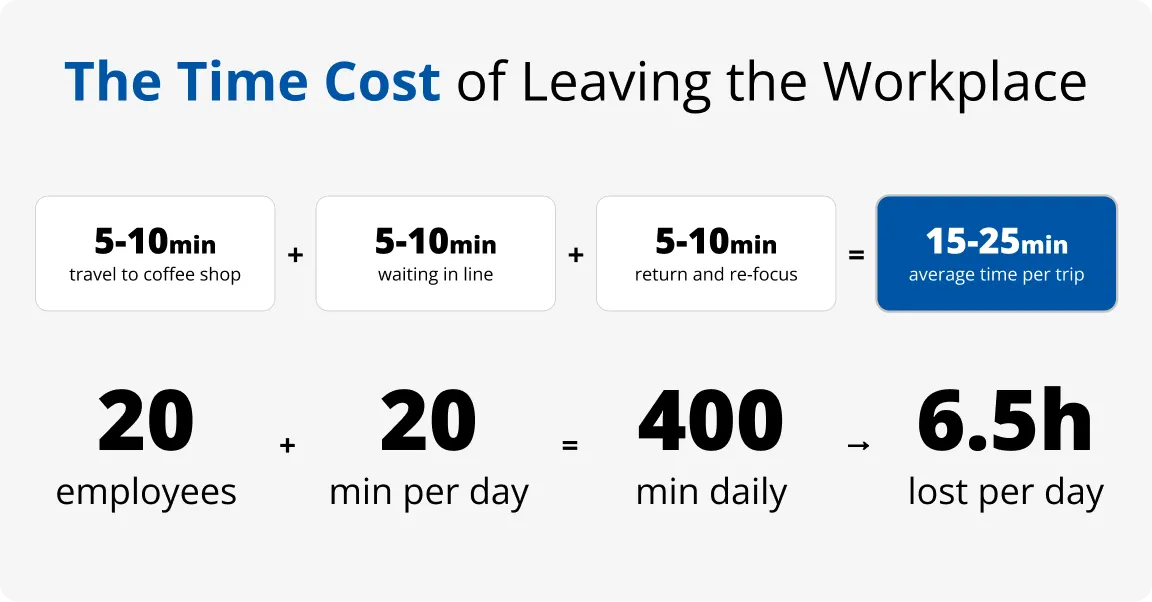
A typical coffee run takes:
- 5–10 minutes travel
- 5–10 minutes waiting
- 5–10 minutes return and re-focus
Average time per trip: 15–25 minutes
For one employee this seems minimal. Across an organization, it accumulates quickly.
Example:
20 employees × 20 minutes per day = 400 minutes daily
That equals over 6.5 hours of lost work time per day
Over a year, that becomes hundreds of labor hours.
The Productivity Impact
The cost is not just time outside the building.
Context switching reduces workflow efficiency. After returning, employees typically require several minutes to resume concentration.
Repeated interruptions affect:
- task completion speed
- meeting schedules
- collaboration timing
- response times
The effect compounds across departments.
Direct Spending vs Indirect Cost
Businesses often look only at the price of providing coffee internally.
But employees already purchase coffee, the difference is where the cost appears.
Workplace Experience Considerations
Employees leave the building not only for caffeine but for convenience and consistency.
If refreshments are reliable on-site, many trips naturally decrease without requiring policy changes.
Organizations implementing modern beverage programs often notice:
- fewer extended breaks
- improved availability
- more consistent schedules
When On-Site Solutions Make Sense
Workplaces benefit most when:
- teams work scheduled shifts
- collaboration is time-sensitive
- employees cannot easily leave and return
- productivity interruptions impact operations
In these environments, convenience directly supports workflow continuity.
Evaluating the Real Cost
Instead of comparing drink price alone, companies evaluate:
- number of daily trips
- average time away
- number of employees affected
- workflow disruption frequency
This gives a more accurate picture of operational impact than beverage cost alone.
Coffee runs feel small individually but become significant operational costs when multiplied across teams and days. The decision between off-site and on-site coffee is less about beverages and more about workflow continuity and time efficiency.
Organizations that analyze the full impact often find that convenience solutions support both productivity and employee experience.

Have a topic you’d like us to cover?
Contact us and let us know how we can help!
You Might Also Like:
Explore our latest and most popular posts, updated regularly to keep you in the know.